
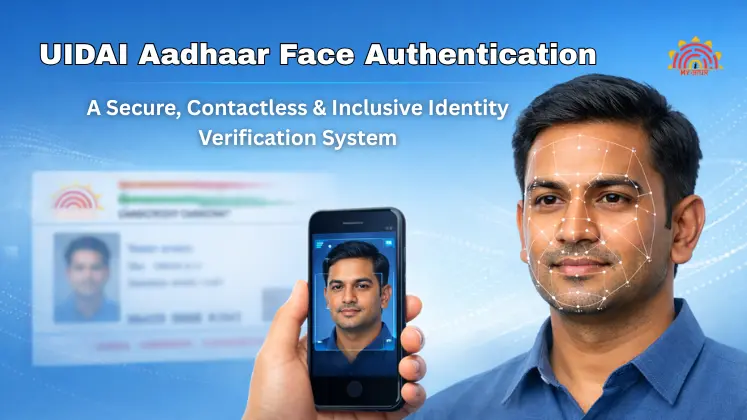
At the end of December 2025, the Unique Identification Authority of India (UIDAI) had achieved a major milestone in the management of digital identity after officially recognizing Aadhaar face authentication as the entirely legitimate, safe, and equivalent Aadhaar verification method. The announcement of the Aadhaar (Authentication and Offline Verification) Amendment Regulations 2025, at the start of December, was the means to do so. The amendments are fully compatible with the Digital Personal Data Protection (DPDP) Act, 2023, which is focused on privacy and consent, as well as limited data sharing. The update represents a major evolution to an inclusive, contactless, and user-friendly system of digital identities in India, eliminating obstacles for millions of people who experience difficulty with the traditional biometric systems.
Aadhaar is the biggest biometrically based identity program in the world. Introduced in 2010, it offers a 12-digit unique identification number to the Indian residents, which is supported by the demographic and biometric information. It is the basis of access to vital services today, with in excess of 1.3 billion enrollments, which means virtually the whole population is covered. Since government welfare schemes, direct benefit transfers, banking, telecom subscriptions, and financial inclusion programs use Aadhaar authentication, it is used to make sure that services are received by the users and generates minimum leakage and fraud. Nevertheless, conventional forms of authentication, such as iris scans and fingerprints, although they are strong, have shortcomings. Fingerprints are inadequate in the case of manual workers because of wear and tear, old people with dry skin, or people with certain illnesses. The iris scan is susceptible to lighting conditions or eye-related problems. Aadhaar Face authentication comes in as an important, inclusive alternative at this point.
The Evolution and Rapid Growth of Aadhaar Authentication
The Aadhaar authentication process started with the simple demographic checkup and one-time passwords (OTPs) delivered through registered telephone numbers. With time it added sophisticated biometrics: fingerprints and iris scans to ensure the higher levels of assurance. In October 2021, face authentication was piloted, and it is implemented through the application of advanced artificial intelligence and machine learning (AI/ML) technologies that were developed fully in-house by engineers at UIDAI. This native development guaranteed the strict regulation of security and privacy options.
Aadhaar Face authentication was originally a slow-user-adopted technology that turned fast. By the beginning of 2025, the cumulative transactions were already over 100 crore. This figure has increased in the first half year to more than 200 crore by August 2025. The monthly records surpassed the expectations with the highest point of 19.36 crore transactions in July 2025 and 18.6 crore transactions in August. By the end of 2025, it is estimated that there will be nearly 29 crore transactions within some of the categories. This feature has been integrated by more than 150 registered entities, including large banks, telecommunication companies, government ministries, and even oil marketing companies. This is not just a testament to the dependability of technology but also to a general acceptance and trust of the population, especially following the revision of 2025, which made the legal provisions of the implementation of such technologies more transparent.
Understanding Aadhaar Face Authentication: Technical Details and Process
At its core, Aadhaar Face Authentication is a complex but uncomplicated technology of biometric authentication, which is based on a live facial capture. Importantly, it employs matching 1:1, i.e., comparing the image taken to the single image of a face held in the secure Central Identities Data Repository (CIDR) at UIDAI, on first enrollment. This is a stark contrast to the controversial 1:N (one-to-many) systems employed in certain surveillance applications to ensure that no broad searching and profiling is done.
The authentication is security-oriented, fast, and convenient:
- Request Initiation: It begins with verification initiated by a service provider (like one of the branches of a bank or hotel) or an individual using a mobile app.
- Live Facial Capture: The client stares at the camera of a compatible device. Liveness detection algorithms are designed to create advanced algorithms, which study small movements, textures, and depth to identify a real individual with photographs, videos, and masks, making it difficult to spoof the algorithm.
- Consent and Proof of Presence: The permission is to be given by the user with the use of a checkbox or a button. Such a measure ensures physical presence, which is also an anti-impersonation measure.
- Encrypted Transmission: The captured image will be encrypted right away and sent to CIDR.
- Matching Algorithm: The comparison is carried out by proprietary AI/ML models of UIDAI, and the response will be binary with respect to the result, Yes/No, and only the basic demographic confirmation in case of necessity.
- Completion: No end-to-end privacy is ever compromised, as there is no biometric data that is shared or is stored by the requesting entity.
The whole operation takes a matter of seconds and is completely contactless, which contributes to hygiene in particular during the post-pandemic period, and works on standard Android or iOS smartphones with sufficient cameras. It has been introduced as a multi-modal feature allowing it to operate with fingerprints, irises, OTPs, or even demographic information individually. The feature is automatic to all holders since facial photos are required at the time of registering on Aadhaar or updating the profile; no extra actions need to be taken.
Service consumers combine through the Face Registered Device (RD) protocol of UIDAI, typically the headless Aadhaar Face RD application that is downloadable on Google Play. Specific use cases are also supported by self-assisted authentication.
The Transformative 2025 Amendment Regulations
The amendment regulations (announced December 9, 2025) are a complete revision based on privacy and ease of use:
- Full Legal Recognition: Face authentication is now equal to other means and can be used in any situation where it used to be prohibited.
- Advanced Offline Capabilities: You can now introduce Aadhaar verifiable credentials and an improved QR code where the user can share signed data without connecting to a server in real-time. This aids in offline validation in various environments, e.g., hotel check-in, concert entry, package delivery, or secure access in offices and government schemes.
- Strengthened Privacy Measures: Consent is non-negotiable; users share data selectively (i.e., name and photo only); there is a data-minimization rule; and third-party leakage is not allowed. Parties that want offline functions have to subscribe as Offline Verification Seeking Entities (OVSEs).
- Revamped Aadhaar Mobile App: Launched in December 2025, the app will have a new face-based authentication, offline scanning, secure QR generation, address update via OTP in addition to face authentication, multi-profile support, biometric locking, and even requesting PVC card options with a user-friendly interface to compete with the popular UPI apps.
These reforms do away with ambiguities in the past, discourage malpractices such as the requirement of physical photocopies, and offer reliability even in the poorly connected areas.
Comprehensive Benefits Driving Adoption
The benefits of face authentication cut across all segments of the society:
- Unparalleled Inclusivity: It fills the gaps of vulnerable groups to the extent that elderly pensioners, rural workers, and differently-abled persons can verify easily.
- Everyday Convenience: It has some smartphone functionality and is even touch-free, as well as befitting contemporary lifestyles and health-conscious settings.
- Ironclad Security: Zero biometric retention and real-time liveness checks reduce risks by third parties.
- Operational Efficiency: The reduced queues in banks and increased disbursement of subsidies and simplified travel procedures are of benefit to millions of people every day.
- Evidence of Trust: Billions of successful transactions and daily highs of over 1.5 crore testify to high performance.
It also enhances financial inclusion through high-value transactions and remote e-KYC, which is secure.
Practical Guide: Using Face Authentication Today
Users can start immediately:
- Install the new Aadhaar official app for personal management and offline sharing.
- In the case of service-led scenarios, take provider directions, which can be by their app calling Face RD service.
- Most of the modern smartphones are compatible; the Face RD application takes care of the capture.
- Make updates such as address changes over the internet by using face and OTP.
UIDAI highly recommends employing Aadhaar in a liberal manner and making sure they do not post on social media.
Robust Privacy and Security Framework
UIDAI takes issues into consideration:
- No surveillance implications, only 1:1 and consent-based.
- Limitation of purpose and harsh punishment of violations in DPDP and Aadhaar Acts.
- Image storage via temporary storage without a provider.
- Anonymized aggregated data and utilized only in improving the system.
- Families are advised on security measures.
Conclusion: Pioneering Inclusive Digital Identity
The new technology of face authentication, which is enabled by the amendments of 2025 and the famous application, is the solution to the problem: a new digital verification in India that is the most secure, impartial, and respectful of individual privacy. Using built-in AI and focusing on user control makes it easy to simplify everyday deals, welfare services, and personalized services and protect against fraud.
With India rapidly moving to a trillion-dollar digital economy, this technology will ensure that all citizens are given an equal chance so that nobody is left out. As transactions are approaching billions of dollars with more integrations, face authentication is positioned to become the appropriate seamless standard of identity proofing.
In order to follow the latest events, refer to the official UIDAI portals, MyAadhaar applications, and government publications.
FAQs
Q. What is Aadhaar Face Authentication?
A. A contactless biometric method that verifies identity by comparing a live facial scan (1:1) to the photo stored in the UIDAI database during the enrolment.
Q. How does Aadhaar Face Authentication work?
A. A live picture is captured on a similar device, verified as lively to stop spoofing, encrypted and only compared with your stored facial picture in CIDR. It returns a Yes/No response.
Q. Can Face Authentication be used offline?
A. Yes, using the new Aadhaar app (released 2025), face scans and verifiable credentials can be supported offline.
Q. What are the benefits of Face Authentication?
A. Inclusive of old/workers with fingerprint problems, touchless/clean, quick, and a complement to other technologies such as fingerprint/iris/OTP.
Q. Who can use Face Authentication?
A. Every Aadhaar holder; linked by more than 150 organizations such as banks, telecom and government schemes to services/welfare.